TV Antenna Indoor, Long Range Antenna for Smart TV with Amplifier Signal Booster for Local Channels, Digital Indoor Antenna, Supports 4K 1080p, 33ft Long Cables Review (2026)
Updated September 20, 2026 · Research-based review
Our verdict
This indoor antenna suits anyone wanting free local channels without a roof install, thanks to a 33ft cable reaching a high window far from the TV. The built-in amplifier helps with weaker signals, but like any indoor antenna it depends on distance to broadcast towers, so rural reception can stay limited.
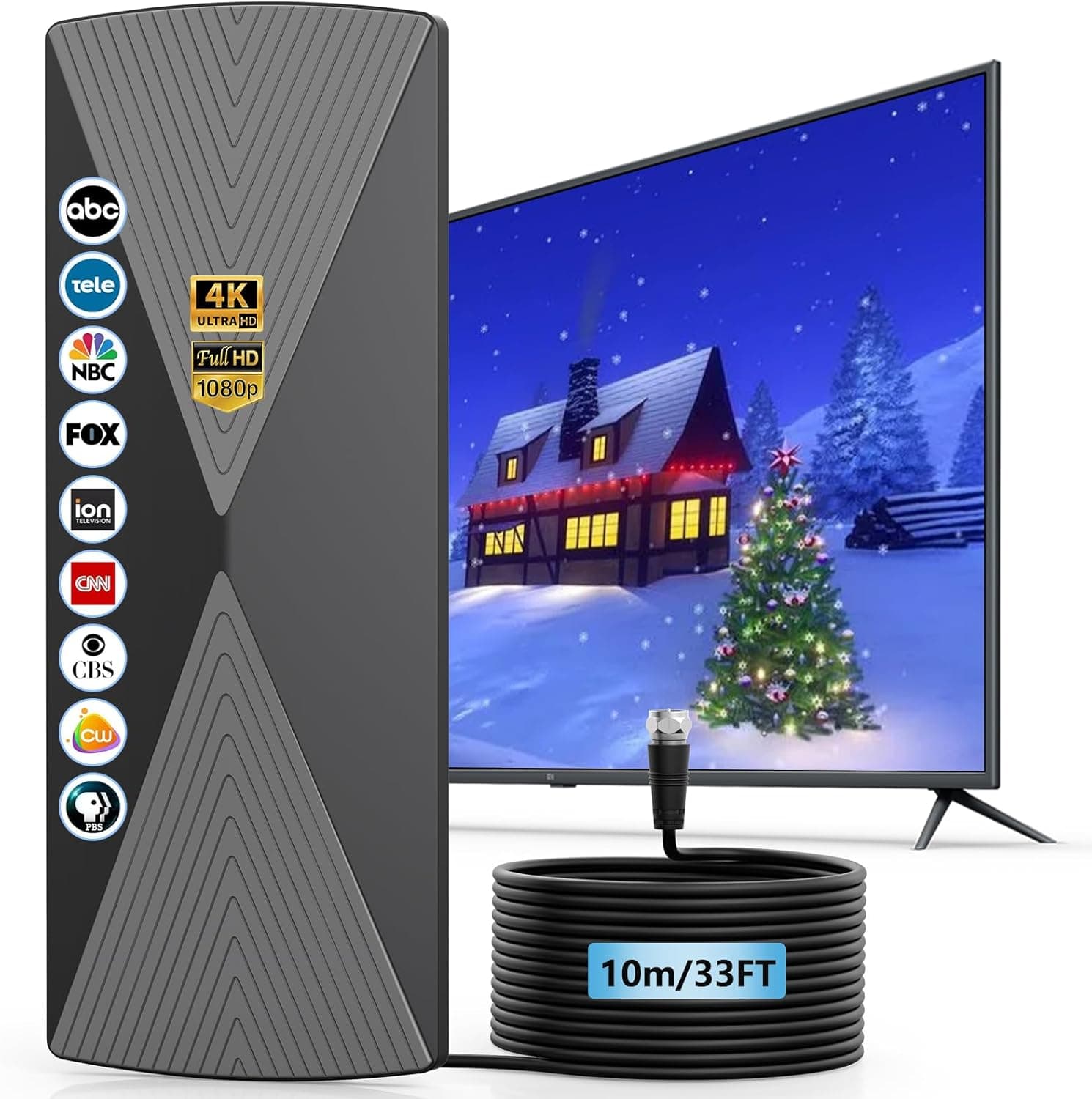
An indoor long range smart TV antenna with an amplifier signal booster and 33ft long cables for local channels.
Price range: See on Amazon
What we liked
- + 33ft cables let you place it far from the TV at a high window
- + Amplifier booster helps with weaker signals
- + Digital indoor design avoids roof or attic installs
Trade-offs
- - Long cable runs add signal loss without the booster
- - Indoor antennas struggle in rural areas far from towers
Who this antenna fits
This is a flat, indoor TV antenna built for cord cutters who want access to free over-the-air local channels such as news, network affiliates, and sports broadcasts without paying for cable or satellite. It fits households within a reasonable distance of local broadcast towers, typically in suburban or urban areas, more than homes in remote rural locations where towers are far away and signal strength drops off. Because it supports 4K and 1080p digital broadcasts, it works well for anyone with a newer smart TV or older set with a digital tuner, and the listing specifically calls out compatibility with older TVs as well as current smart TVs. Buyers should still check their address against a coverage tool before assuming which channels and how many will actually come in clearly at their specific location.
Cable length and placement flexibility
The antenna ships with a 33ft cable, which is considerably longer than the coax cables bundled with many budget indoor antennas, giving buyers room to mount or place the antenna at a high window, near an attic access point, or on an exterior-facing wall while keeping the TV in its normal spot across the room. This matters because antenna placement height and line of sight toward broadcast towers has a large effect on reception quality, so a longer cable makes it easier to experiment with different spots without being tied to a location within a couple of feet of the TV. The trade-off with any long cable run is a small amount of additional signal loss compared to a short cable, which is part of why the antenna includes a signal amplifier in the first place.
Amplifier and signal boosting
The listing includes a built-in amplifier signal booster designed to help pull in weaker over-the-air signals, which is a common feature on indoor antennas competing with the noise and interference found inside most homes, including walls, appliances, and other electronics. An amplifier can meaningfully improve the number of watchable channels in fringe reception areas, but it is not a substitute for a clear line of sight to broadcast towers, and in some cases an amplifier can even oversaturate a very strong nearby signal and cause more interference rather than less. Most manufacturers recommend testing with the amplifier both on and off during initial setup to see which gives a cleaner scan result for a specific location.
Setup and channel scanning
Getting channels requires connecting the antenna's coax output to the antenna or RF input on the back of the TV, then running the TV's built-in channel scan or auto-tune feature to search for available digital broadcasts, which is a standard process across nearly all indoor antennas rather than something unique to this model. Before buying or during setup, checking a station locator tool such as the FCC's DTV reception maps against a home address is worth doing, since it shows roughly how many stations should be available and how far away their towers sit, which helps set realistic expectations. Placement near a window facing the direction of local towers, and away from large metal objects or other electronics, tends to produce the best scan results for any flat indoor antenna including this one.
Realistic expectations for reception
Like all indoor antennas, this model's real-world performance depends far more on distance to towers, terrain, and building materials than on any single antenna's marketing claims, so buyers in dense urban areas close to towers will likely see strong results while those in rural or heavily wooded areas may only pull in a handful of channels even with the amplifier engaged. The 33ft cable and amplifier both help maximize the chances of a good result by giving more placement options and a boost for marginal signals, but they cannot substitute for proximity to broadcast towers. Anyone unsure about their local station situation should check a coverage map first, since that is a better predictor of results than any single antenna's features.
Frequently asked questions
How long is the included cable?
The antenna comes with a 33ft cable, giving more flexibility to place it near a high window or wall away from the TV.
Does it need an amplifier to work?
The antenna includes a built-in amplifier signal booster, though results still depend on distance to local broadcast towers and surrounding obstructions.
Will it work with an older TV?
Yes, the listing states it is designed to work with older TVs as well as current smart TVs, supporting 4K and 1080p digital broadcasts.
How do I know which channels I can get?
Checking an online station locator or coverage map for a specific address before buying gives a realistic idea of how many local channels should be receivable.
Prices change often, so check the current price and availability on Amazon.
Check price on AmazonHome Theater Setup Hub may earn a commission from the link above.