Amplified HD Digital TV Antenna Long Range Reception, Support 4K 1080p, Local Channels, Smart Switch Amplifier Signal Booster - 17ft Coax Cable/AC Adapter Review (2026)
Updated September 21, 2026 · Research-based review
Our verdict
This amplified indoor antenna suits cord-cutters who want free local channels alongside streaming, using a smart switch amplifier and 17 foot coax cable to reach a wall-mounted TV from a high spot. Reception depends on distance and terrain to local towers, so treat the range claim as best-case, not a guarantee.
An amplified HD digital TV antenna with a smart switch amplifier, 17ft coax cable and AC adapter for long range reception.
Price range: See on Amazon
What we liked
- + Smart switch amplifier toggles boost for near or far towers
- + 17ft coax gives room to mount it high on a wall
- + AC adapter provides steady power for the amplifier
Trade-offs
- - Long range wording is vague, so check tower distance first
- - Needs an outlet near the TV for the AC adapter
Amplified reception and the smart switch
The antenna includes a built-in amplifier with a smart switch, letting owners toggle the boost level depending on how close they are to local broadcast towers, since an amplifier set too strong can actually cause signal overload and dropped channels for households near a tower rather than improving reception. For homes farther from towers, the amplified setting helps pull in a weaker signal that an unamplified antenna might miss entirely. This adjustable approach is a genuine practical feature over a fixed, always-on amplifier, since it lets one antenna work reasonably well across a range of distances rather than being tuned for only one scenario. An AC adapter powers the amplifier, so the antenna needs an outlet near wherever it is mounted.
Range claims and realistic expectations
Antenna listings in this category commonly advertise long mileage ranges under ideal, unobstructed conditions, and this antenna is no exception, but actual reception in a real home depends heavily on terrain, building materials, distance from the nearest broadcast tower, and even weather. Buyers should check their specific address against a broadcast tower locator tool before assuming a stated range figure will hold up in their home, since hills, dense trees, or being surrounded by other buildings can all cut effective range well below an advertised best-case number. Mounting the antenna as high as possible, such as near a window or in an attic, generally improves results more than relying on the amplifier alone to overcome distance or obstructions.
Cable length and mounting flexibility
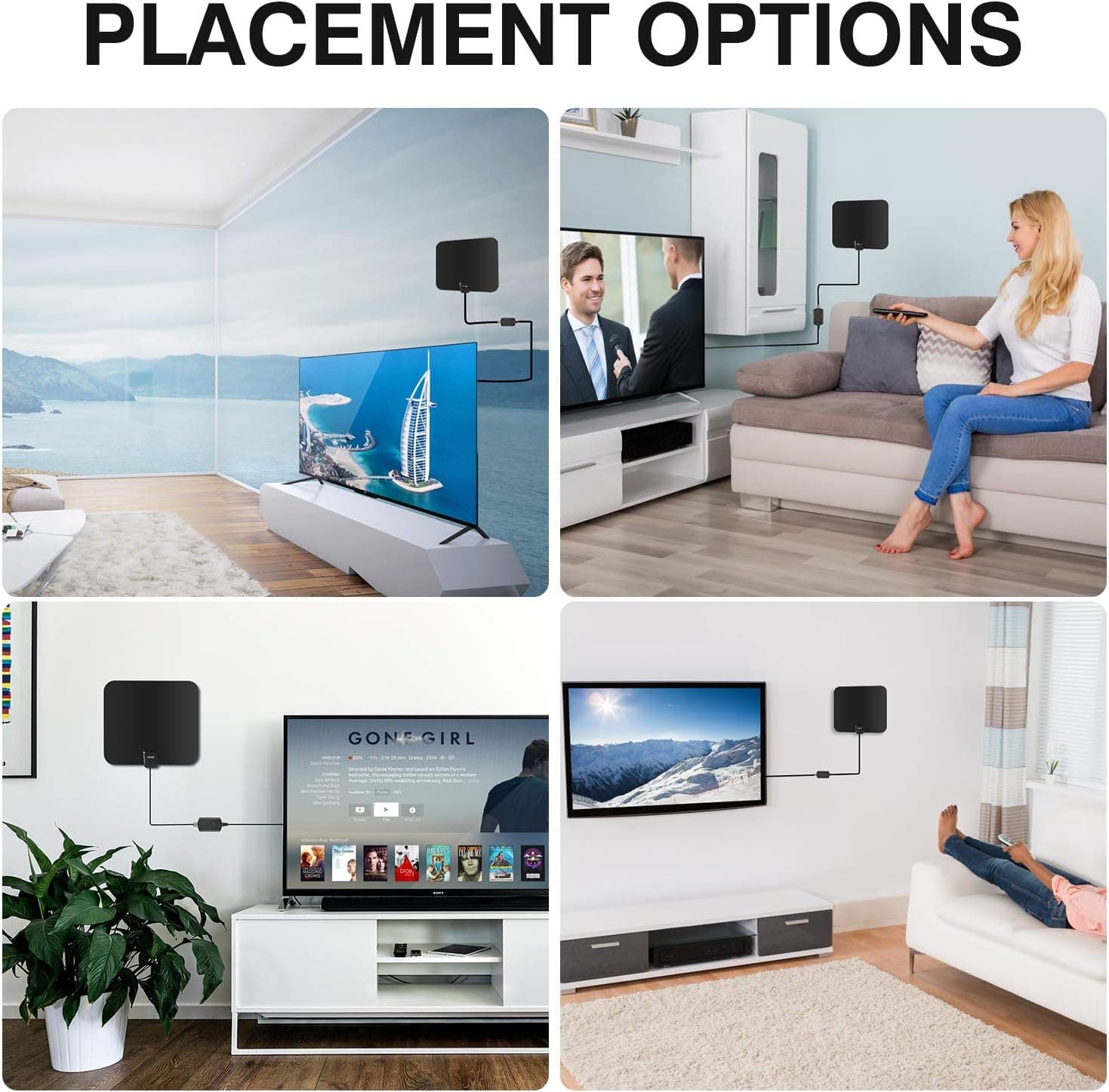
A 17 foot coax cable gives enough length to mount the antenna high on a wall, near a window, or in an attic space while still reaching a TV or tuner box positioned elsewhere in the room, which matters because antenna height and window proximity generally matter more for reception than exact antenna model. The cable uses standard coax connectors, compatible with the tuner input on most modern TVs as well as external ATSC tuner boxes for older sets or streaming devices that lack a built-in tuner. For a home theater setup where the TV sits on a wall far from a good antenna placement spot, this length avoids needing a separate cable extension for most rooms.
Power requirements and placement
Because the amplifier requires external power through the included AC adapter, the antenna needs an accessible outlet somewhere near its mounting location, which can complicate installation in an attic or a high wall spot without a nearby outlet. This is a tradeoff against unamplified antennas that need no power at all, since the amplification generally improves range and reliability enough to be worth the extra outlet requirement for most users pulling in distant stations. Planning the mounting location with both signal quality and outlet access in mind before installing avoids needing an extension cord or a change of plans partway through setup.
Who should consider this antenna
This antenna suits a cord-cutting household that wants free access to local news, sports, and network broadcasts to pair with a streaming setup, particularly if they live within a reasonable distance of broadcast towers and have a good mounting spot with an outlet nearby. Buyers in a genuinely rural or fringe reception area, far from any tower, may find even an amplified indoor antenna insufficient and should consider an outdoor or attic-mounted antenna with a larger element instead. For a typical suburban home within normal broadcast range, this antenna's amplifier and generous cable length make it a reasonable low-cost way to add over-the-air channels to a home theater setup.
Frequently asked questions
Will this antenna really reach the advertised range?
Advertised ranges reflect best-case, unobstructed conditions. Real-world reception depends on terrain, distance from towers, and building materials, so results vary by location.
Does the antenna need to be plugged into an outlet?
Yes, the built-in amplifier is powered through the included AC adapter, so it needs an outlet near its mounting location.
Where should I mount it for the best reception?
Mounting it as high as possible, such as near a window or in an attic, generally improves reception more than relying on the amplifier alone.
Why does it have a smart switch on the amplifier?
The switch lets you adjust the amplifier's boost level, since too much amplification near a broadcast tower can overload the signal and cause dropped channels.
Prices change often, so check the current price and availability on Amazon.
Check price on AmazonHome Theater Setup Hub may earn a commission from the link above.